
What Makes CrossFit Special?
What Makes CrossFit "Special"?
The CrossFit methodology is based on a theoretical hierarchy of health and fitness. Imagine a pyramid where different aspects of our "wellness" are layered on top of each other, supporting and complimenting each other.
Diet — Lays the literal molecular foundations for fitness and health. Your body is actually, physiologically, comprised, built and sustained by what you put into it (eating and drinking). Ultra-processed food, high sugar intake from sweets and soda/sugary drinks literally creates a body structure that is predominantly fat and an environment for disease. You can not be "fit" and eat junk.
Metabolic conditioning — Builds capacity in each of three metabolic pathways, beginning with the aerobic pathway, then the lactic-acid pathway and then the phosphocreatine pathway. Think endurance, stamina, strength and power.
Gymnastics — Establishes functional capacity for body control and range of motion. It is imperative that you learn to control your core and your body in space before attempting to move heavy weights. This will prevent injuries in the medium-to-long-term.
Weightlifting and throwing — Develop the ability to control external objects and produce power. Learn to use your body and strength to move objects. This is strength.
Sport — Applies fitness in a competitive atmosphere with more randomized movements and skill mastery. This is where we have fun playing sports like soccer, football, basketball, pickleball, or running around playing tag with our kids or grand-kids.
Examples of CrossFit Exercises
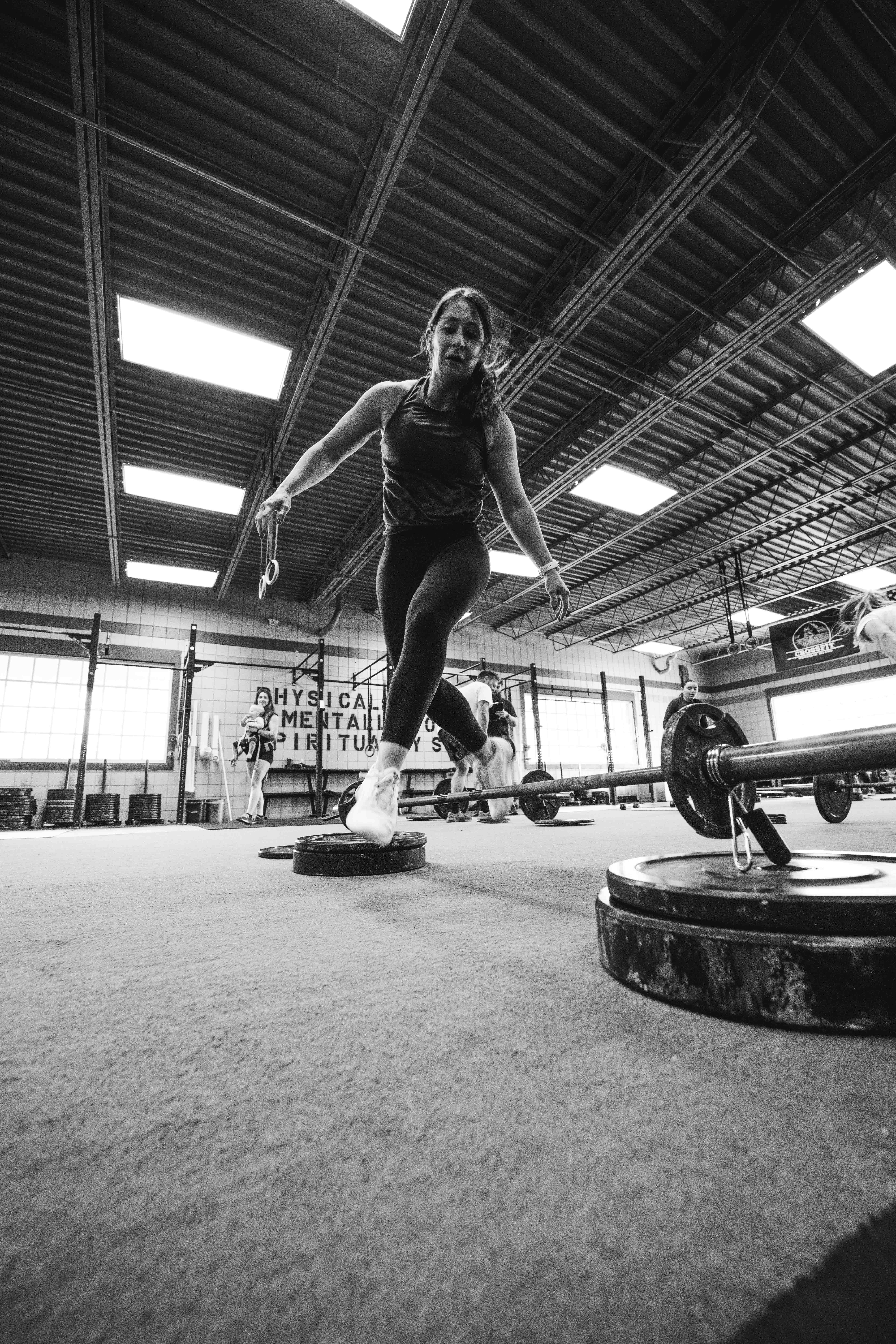
CrossFit is known for it's functional movements, and the variance in which we apply them during workouts. Biking, running, swimming and rowing in an endless variety of drills. Clean and jerks, snatches, squats, deadlifts, push presses, bench presses, and power cleans. Jumping, medicine-ball throws and catches, pull-ups, dips, push-ups, handstands, presses-to-handstands, pirouettes, kips, cartwheels, muscle-ups, sit-ups, scales, and holds. We make regular use of bikes, the track, rowing shells and ergometers, Olympic weight sets, rings, parallel bars, free-exercise mats, horizontal bars, plyometrics boxes, medicine balls, and jump ropes.
There isn’t a strength-and-conditioning program anywhere that works with a greater diversity of tools, modalities and drills. Our professional coaches are trained to meet people where they're at with scaling, modifications, progressions and technical instruction to maintain safety and increase the effectiveness of the training. The variance and exposure to real, functional exercises is part of what drives the results CrossFit, as a program, delivers.
What if I Don’t Have Time for all This?
It is a common sentiment to feel that you don’t have the time to become as fit as you might like because of the obligations of career and family. After having children, I gained a much higher amount of respect for the struggles parents go through with their time and energy. Here’s the good news: World-class, age-group strength and conditioning is obtainable through an hour a day six days per week of training. It turns out the intensity of training that optimizes physical conditioning is not sustainable past 45 minutes to an hour. Athletes who train for hours a day are developing skill or training for sports that include adaptations inconsistent with elite strength and conditioning. Past one hour, more is not better!
“Fringe Athletes”
There is a near-universal misconception that long-distance athletes are fitter than their short-distance counterparts. The triathlete, cyclist and marathoner are often regarded as among the fittest athletes on Earth. Nothing could be further from the truth. The endurance athlete has trained long past any cardiovascular health benefit and has actually lost ground in strength, speed and power; typically these long distance athletes do nothing for coordination, agility, balance, and accuracy; and possess little more than average flexibility, oftentimes being inflexible due to the tightness of the hours spent running and sitting on bicycle. This is hardly the stuff of elite athleticism.
The CrossFit athlete, remember, has trained and practiced for optimal physical competence in all 10 physical skills (cardiovascular/respiratory endurance, stamina, flexibility, strength, power, speed, coordination, agility, balance and accuracy). The excessive aerobic volume of the endurance athlete’s training has cost him in speed, power and strength to the point where his athletic competency has been compromised. No triathlete is in ideal shape to wrestle, box, pole-vault, sprint, play any ball sport, fight fires or do police work. Each of these requires a fitness level far beyond the needs of the endurance athlete.
None of this suggests that being a marathoner, triathlete or other endurance athlete is a bad thing; just don’t believe that training as a long-distance athlete gives you the fitness that is prerequisite to many sports. CrossFit considers sumo wrestlers, triathletes, marathoners and powerlifters to be “fringe athletes” in that their fitness demands are so specialized as to be inconsistent with the adaptations that give maximum competency at all physical challenges. Most of us want the fitness to do whatever we want, whenever we want, with whoever we want. Elite strength and conditioning is a compromise between each of the 10 physical adaptations. Endurance athletes do not balance that compromise, and neither do power lifters or bodybuilders.
Next time, we'll talk about how we layer in the different aspects of fitness found in the Theoretical Hierarchy mentioned above.
In Health,
Coty